
Chamber of Startup Reflections: Part II
With an interesting response to the first part of the Chamber of Reflections before the summer, it's finally time for the promised second part.

You can find the first part here, which delves into more abstract considerations about starting a venture. Now, in this second part, we'll embark on a deeper exploration of fundamental topics like "Niche vs. Long-tail", the delightful chaos of initial design, choosing the right growth channels, and more.

01 Escape Competition
In line with Peter Thiel’s insight, “All failed companies are the same: they failed to escape competition.“ from Zero to One: Notes on Startups, or How to Build the Future, it's imperative to possess a unique vision to create a distinctive product. This unique product, upon launch and demand, effectively becomes a monopoly, akin to a new drug with a patent. This calls for a profound understanding of the target market, competition, and business models, allowing for a dash of differentiation in the creation process. Now, if we stray from this path, we meet two dubious characters:
On one side, replicating something too akin to the current market leads to a mere struggle for margins. This fight will not be won by innovation.
On the flip side, entertaining an overly broad and opportunistic approach with a wild array of features, business models, customer segments, or markets is akin to making a deal with the devil. Sure, one will very probably need to iterate from the initial vision too, but this is leagues apart from not having a wage idea about what you're creating, and leaving every door slightly ajar, only to realize they were never actually open. Such opportunistic behavior might be tempting as it helps to avoid “being wrong” with a more specific vision and idea towards your investors and stakeholders, but time will pass and all these imaginary doors closed.
02 Positioning as the Very First Step
Positioning is intricately linked with the product's vision and is the pivotal long-term bet for your company. It builds the foundation for creating the actual product, for happy customers and maybe the most important, a strong and focused team.
Building something generic to cater to a broad audience, with the hope of achieving high Daily or Monthly Active Users (MAUs), is an impractical approach. It's impossible to address all the specific needs of various sub-segments with a one-size-fits-all product (probably also not at a later stage).
Here’s the plot twist:
Julie Suspans article What I Learned From Developing Branding for Airbnb, Dropbox and Thumbtack in the First Round Review where she talks about the process they went through and crucial time spent on finding the ideal user, the HXC customer:
”The high-expectation customer, or HXC, is the most discerning person within your target demographic. It’s someone who will acknowledge—and enjoy—your product or service for its greatest benefit,” says Supan. That discernment is key, because this customer is also someone who can help startups spread the word.”YC’s mantra “Find 10-100 customers who love your product“ and the famous blog Do things that don’t scale by Paul Graham talking about the required inital manual user aquisition.
”The most common unscalable thing founders have to do at the start is to recruit users manually. Nearly all startups have to. You can't wait for users to come to you. You have to go out and get them. - You should take extraordinary measures not just to acquire users, but also to make them happy. Your first users should feel that signing up with you was one of the best choices they ever made. And you in turn should be racking your brains to think of new ways to delight them.”
03 Niche vs. Long-tail
Much like a tailor crafting a bespoke suit, the product you build should snugly fit the needs of your chosen segment. Offering an extensive range of products, hoping one will catch someone's eye, is counterproductive. Even behemoths like Amazon and PayPal started in niches before expanding. Behavioral science shows that too much choice can lead to analysis paralysis and customer frustration (more about the jam experiment here).
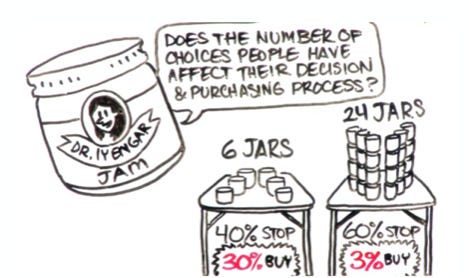
Moreover, offering a wide range of products makes it challenging to address people seeking specific solutions to their problems, as your messaging can't be finely tuned to their niche.
04 Keep your Design Edgy
In a world where trends come and go like seasonal fashion, it’s crucial to hold onto the essence of your initial design. Marc Andreessen once quipped about the design evolution, reminding us not to lose the spark that sets us apart.

With the above points in mind, keep the character and edges of your initial design. Imagine Marissa Mayer at Google, who resisted the siren call of the mainstream. Every step towards a more generic user experience risks blending into the mainstream internet. You can do that once you became big, or keep it like Google did.
05 Fundamentals for Growth
While acquiring your first customers manually is essential, it's equally important to consider the thoughts and technical implications for future growth channels early on. A piece by Dan Hockenmaier and Lenny Rachitsky, Drive Growth by Picking the Right Lane — A Customer Acquisition Playbook for Consumer Startups highlights the three primary growth lanes for consumer companies:
“In our experience, founders are often surprised to learn that there are very few routes to scalable new customer acquisition. For consumer companies, there are only three growth “lanes” that comprise the majority of new customer acquisition:
1. Performance marketing (e.g. Meta and Google ads)
2. Virality (e.g. word-of-mouth, referrals, invites)
3. Content (e.g. SEO, YouTube)
The good news is that you generally only need to excel at one lane to build a successful business. The bad news is that it won’t be easy.“
Choosing the right lane significantly impacts your team composition and requires early consideration. Fortunately, there are numerous insightful articles available online about specific growth methods (read Elena Verna’s substack).
06 The Core Team: Divers Skills, Aligned Intellect
Considering all the above, the individuals around you should bring complementary skills to the table, but share the same wavelength intellectually. You’re on a tightrope, and strong alignment with the team on the items above is your safety net. Choosing your comrades wisely, despite the ticking clock.

This is all a little mantra-like praise and typically you learn much more efficient through failure. Just that in this case it is the opposite of a “safe pace” to make mistakes. I hope reading this helps a little, at least.
All the best!